The Columbia Lot
Hollywood's Forgotten Rock 'n' Roll Production Campus
How former movie soundstages became a rehearsal, sound, lighting, scenery, trucking, management, and early video hub in the 1970s
A living article
This is not being presented as the final word on the Columbia Lot. It is a documented working history built from period trade reporting, directories, recordings, photographs, oral histories, and surviving artifacts. The article is intended to be updated as more people come forward with corrections, dates, photographs, paperwork, stage maps, and firsthand accounts.
Version 1.0 | First published August 2, 2026 | Last updated August 2, 2026
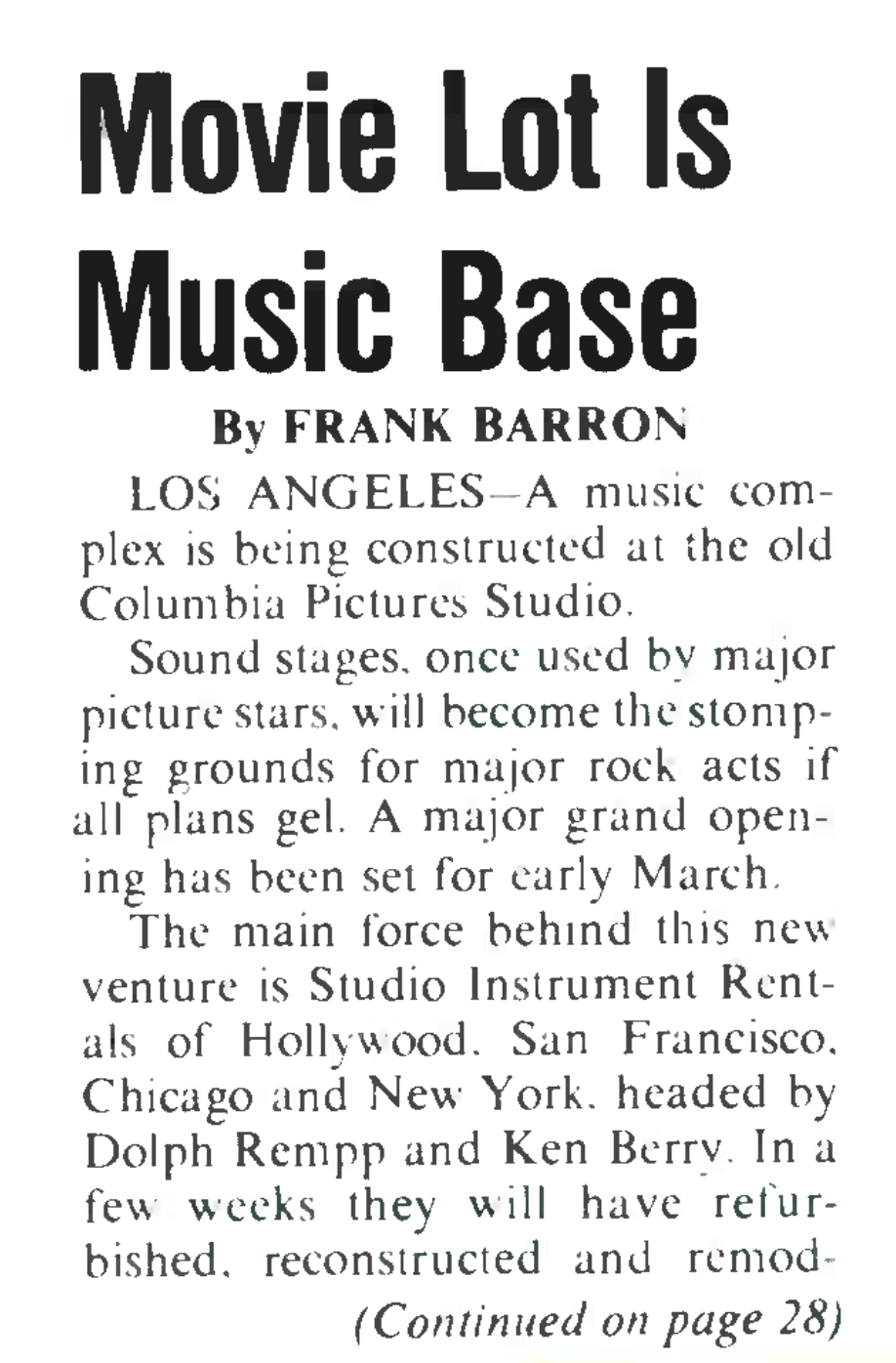
Frank Barron's "Movie Lot Is Music Base," Billboard, February 14, 1976
1. How this story began
The more I have researched the West Coast live sound industry of the 1960s and 1970s, the more obvious it has become that this history cannot be told only through individual sound companies. The companies mattered, but so did the places where people, equipment, ideas, artists, managers, truck drivers, lighting crews, builders, and technicians crossed paths. One of the clearest examples I have found is the former Columbia Pictures lot in Hollywood, a place that people who worked there remember simply as the Columbia Lot, the lot, or the Rock 'n' Roll Lot.
At first, this looked like a smaller story about Pirate Sound, a little documented rehearsal operation tied to Deep Purple, Tycobrahe, Robert Simon, and John 'Mad John' DeBord. As the research expanded, Pirate Sound turned out to be the entrance to a much larger story. By the second half of the 1970s, former movie soundstages and the businesses around them had become a working production community where a band could rehearse a tour, test a sound system, bring in lighting and scenery, retrieve backline, solve equipment problems, meet crew, connect with management, and load trucks from the same property or immediate cluster of buildings.
That does not mean every company was under one owner or that every service was available every day. The evidence points to a collection of independent businesses that benefited from being close together. That distinction matters because the importance of the Columbia Lot was not a corporate master plan alone. Its importance came from the combined capabilities, people, and daily traffic that gathered there.
The result is a story that sits directly inside the history of live sound. The stages were not only places for musicians to play. They were full-scale testing environments where a tour could be assembled before an audience ever saw it. The Columbia Lot helped move rehearsal away from a simple room with instruments and toward something much closer to modern production preparation.
2. When a movie lot became a rehearsal lot
The property at Gower Street and Sunset Boulevard had been Columbia Pictures' long-time Hollywood home. Columbia left the lot in the early 1970s, and later property histories describe a period when much of the site fell into disrepair or sat underused. Some of the large stages were converted to indoor tennis use, while other areas were available for short-term rental and adaptive reuse. It was an unusual moment when a major studio property still had the scale, power, access, and physical separation needed for production, but not yet a stable new identity.
That opening lined up with a growing problem in the concert industry. Touring productions were getting larger, louder, and more complicated, but most bands still prepared shows in scattered rehearsal rooms, warehouses, shops, and the first venues of a tour. Large movie stages offered something different. They had height, floor space, loading access, electrical infrastructure, and enough isolation to run a serious sound system without treating rehearsal as a scaled-down version of the show.
The period Billboard article that unlocked much of this history described a fourteen-stage property, with five stages being used as tennis courts at the time. It also identified Burbank Studios president Robert Hagel as operating the property during the transition, with Dan Chaccia handling rentals for the Hollywood stages from Burbank. Those details show that the music community did not simply wander into abandoned buildings. There was an active, if still changing, stage-rental and property-management structure behind the scenes.
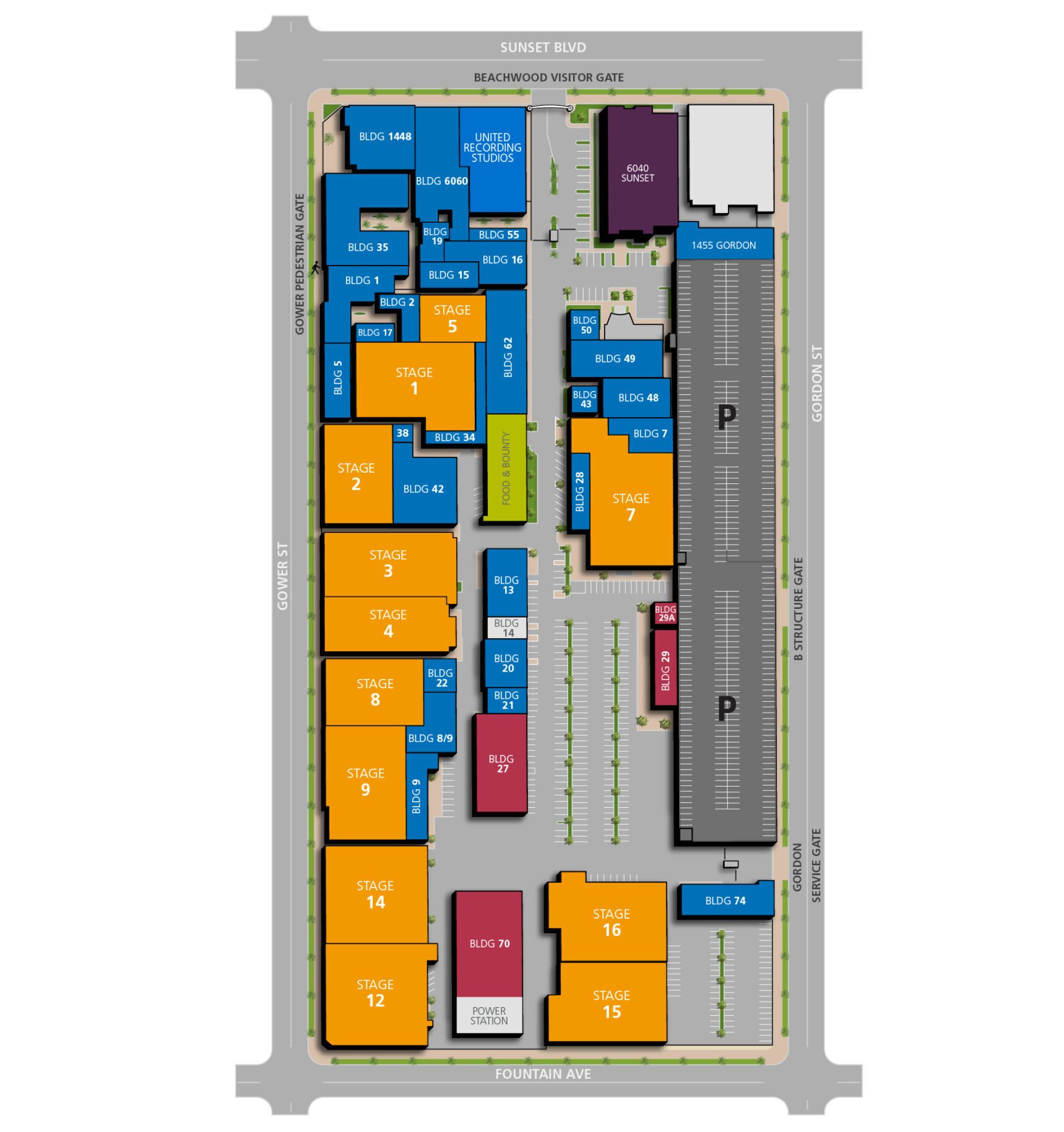
Current Sunset Gower lot map. This is useful for orientation only and should not be treated as a confirmed map of 1975 to 1979 tenant locations.
3. Pirate Sound and the first documented phase
The earliest clearly documented music-production operation on the former Columbia stages was Pirate Sound. Frank Barron's February 14, 1976 Billboard report said that Pirate Sound had arrived the previous March, which places the beginning of its Columbia Lot operation around March 1975. The article identified John DeBord and Robert Simon as two former Deep Purple soundmen and said they occupied three stages. Pirate Sound reinforced the stages for sound, supplied additional power and heat, and rented the spaces to major acts preparing to go on tour.
The two men are now central to the story. Robert Simon was already connected to Deep Purple's touring sound world and is remembered by former Tycobrahe employee Bill Hennigh as the company's salaried engineer for the band. John DeBord, known as 'Mad John,' had a long Tycobrahe technical connection and later moved into specialized monitor-system work. Period Rainbow equipment reporting credited 'Mad John and Simon' with developing and building keyboard and bass cabinets, which gives Pirate Sound a second identity beyond stage rental. It was also a place where custom road equipment and practical touring solutions were being developed.
The strongest dated proof of Pirate Sound's activity is Deep Purple's June 1975 rehearsal period. Recordings later released as Days May Come and Days May Go, also associated with the address 1420 Beachwood Drive, capture the Mark IV lineup working through improvisations, arrangements, lineup development, and early song ideas. Robert Simon is credited as engineer. These were not casual rehearsals. They were creative sessions, technical rehearsals, and recordings made inside a production environment that was still taking shape.
Billboard named Bad Company, Elton John, Black Sabbath, Led Zeppelin, and the Hudson Brothers as acts that had rehearsed their shows at Pirate Sound before touring. Later dated evidence adds Deep Purple, Rainbow, Frank Zappa, and Rod Stewart. The growing list matters, but the larger point is what those artists were doing there. Pirate Sound gave major touring acts a place to build a show at meaningful scale before the first public performance.
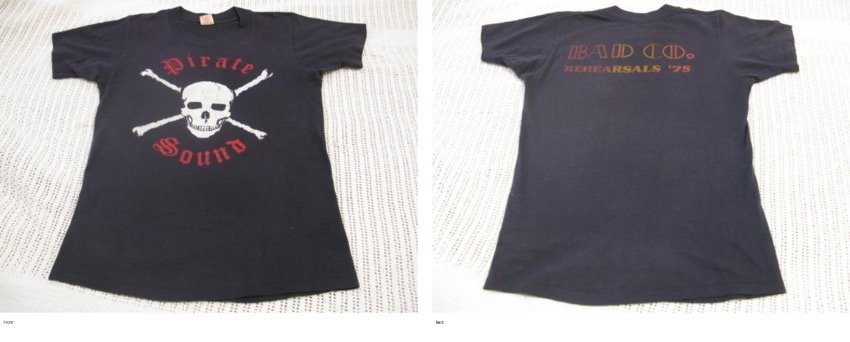
Surviving Pirate Sound / Bad Company rehearsal shirt. The artifact supports Pirate Sound branding and the Bad Company rehearsal connection.
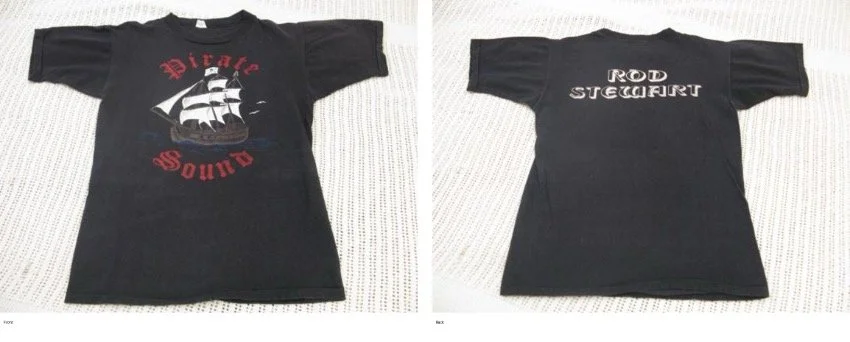
Surviving Pirate Sound / Rod Stewart rehearsal shirt. The shirt is consistent with period reporting that Rod Stewart rehearsed at Pirate Sound in September 1976.
Working Research Record
Pirate Sound Artists and Rehearsals
The surviving record confirms that Pirate Sound was used by several major touring acts during the mid-1970s. This table separates contemporary documentation from later firsthand recollections and research leads. Dates should be read as the earliest or most specific period currently supported by the available evidence.
| Artist | Date or Period | Current Evidence | What We Know |
|---|---|---|---|
| Deep Purple | June 1975 | Rehearsal recordings, credits, photographs and firsthand crew accounts | The strongest precisely dated Pirate Sound case currently documented. The surviving rehearsal material provides evidence of the band, the room and the technical environment. |
| Bad Company | By February 1976 | Contemporary Billboard reporting and surviving Pirate Sound shirt | Listed among the major artists using Pirate Sound. The exact rehearsal dates and tour-preparation purpose remain unresolved. |
| Elton John | By February 1976 | Contemporary Billboard reporting | Identified as a Pirate Sound client. The particular tour, system provider and exact rehearsal dates still need to be confirmed. |
| Black Sabbath | By February 1976 | Contemporary Billboard reporting | Identified among the artists using Pirate Sound. The specific rehearsal period and production details remain open. |
| Led Zeppelin | By February 1976 | Contemporary Billboard reporting | Listed as a Pirate Sound client. The evidence does not yet identify the exact dates, stage or tour-preparation schedule. |
| Hudson Brothers | By February 1976 | Contemporary Billboard reporting | Included in the period client list, although little additional rehearsal or equipment documentation has been located. |
| Rod Stewart | September 1976 | Period reporting and a surviving Pirate Sound artifact tied to the rehearsal period | One of the strongest later-1976 artist connections. Additional documentation is still needed to identify the stage and complete rehearsal schedule. |
| Frank Zappa | Mid-1970s | Firsthand crew recollection involving Pirate Sound and SIR gear | A credible oral-history connection, but the precise date, rehearsal stage and equipment arrangement still need documentary support. |
| Rainbow | Later 1970s | Equipment credits and personnel connections involving Robert Simon and John “Mad John” DeBord | The technical and personnel relationship is meaningful, although a specific Pirate Sound rehearsal date has not yet been established. |
Swipe or scroll sideways to view the full table
This is a living research table. Additional artists, dates and corrections will be added as period records, photographs and firsthand accounts are located.
4. SIR and the wider production complex
Pirate Sound was the early anchor, but the Columbia Lot story becomes much larger in 1976. Billboard identified Studio Instrument Rentals, led by Dolph Rempp and Ken Berry, as the main force behind a broader music complex on the property. SIR was already an established rehearsal, backline, and rental company with roots going back to Los Angeles in 1967. At Columbia, the company announced plans for two stages and approximately 40,000 square feet of space.
The planned service mix was remarkably broad. It included rehearsal, equipment storage, production workshops, sound, film, and video equipment, immediate videotape review, cartage, freight forwarding, instrument displays, hospitality, a registration or employment service for musicians and roadies, and dedicated space for Arnold Zane to manufacture instrument cases. This was not simply a larger rehearsal-room business. It was an attempt to place many of the practical functions needed to prepare a tour in one location.
Some caution is still necessary. A period announcement proves that these services were planned and that SIR was investing heavily in the operation. It does not prove that every announced division opened exactly as described or remained active for the same length of time. One of the next major research jobs is to separate the planned SIR campus from the services that workers and clients can confirm actually operated.
The best evidence suggests that SIR and Pirate Sound were separate but complementary operations. No common ownership has been established, and there is no proof that SIR absorbed Pirate Sound. The Frank Zappa rehearsal story gives a useful picture of how the relationship worked in practice. Road equipment connected to SIR was retrieved and moved to nearby Pirate Sound so rehearsals could begin, showing storage, rental, and full-production rehearsal operating beside one another.
5. 1420 Beachwood and the companies around it
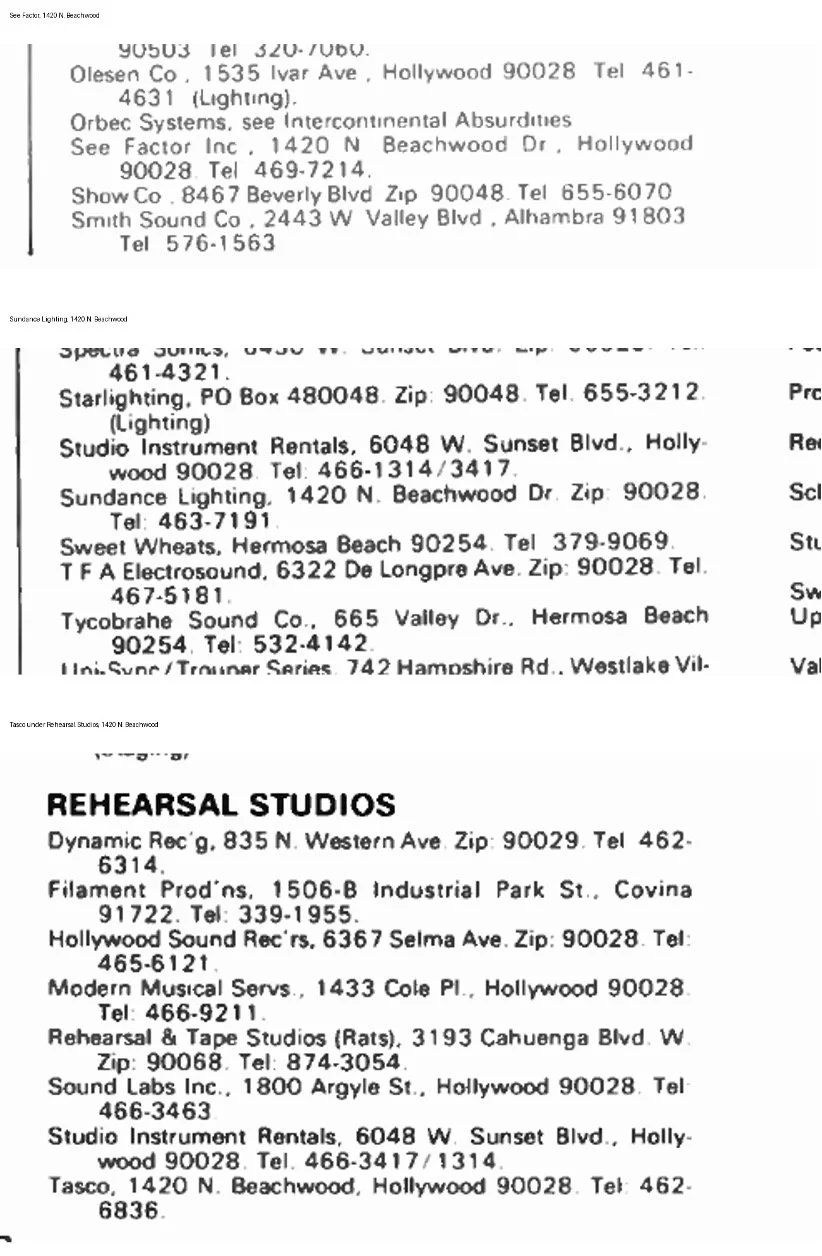
By the late 1970s, 1420 North Beachwood Drive appears repeatedly in period directories. It should be understood as a shared campus or gate address, not as proof that every listed company occupied one building. The companies had separate telephone numbers and separate corporate identities. What the address proves is that a remarkable group of independent touring-production businesses operated from the same studio property.
A-1 Audio Rentals was listed at 1420 Beachwood by September 1977, before David Morgan joined the company in 1978. The 1978-1979 Billboard International Talent Directory separately listed See Factor, Sundance Lighting, and Tasco at the same address. Tasco appeared under Rehearsal Studios, which suggests a rehearsal-related operation rather than a mailing address alone. By 1980, A1 had moved to De Longpre Avenue, Sundance was listed in Chatsworth, and Tasco was in Carson, while See Factor Pacific remained at Beachwood. A 1988 Mix directory still listed See Factor Industry at 1420 Beachwood.
6. What daily life on the lot appears to have been like
The directories tell us who was there, but the oral histories begin to explain why the place mattered. David Dansky described the lot as being like 'Disneyland for audio.' David Morgan called it 'just a fun community.' Those descriptions are informal, but they are consistent with the physical concentration documented in the trade sources. The lot was not only a place where companies rented space. It was a place where people could see what other crews were building, hear bands through the walls, move between shops, and find their next job.
Morgan's own entry into A1 Audio shows how the network worked. David 'Dave' Hopkinson, who had worked with Morgan on the Palomino installation, recommended him to A1 founder Al Siniscal. Morgan then entered a world where he could learn what went into a complete touring truck, see other production companies operating nearby, and pick up the practical knowledge that was difficult to learn from a book or a single employer. The lot functioned as an informal school because the work was visible and the people were accessible.
The Tony Carey story makes the labor-market effect even clearer. Carey remembered rehearsing with another act at SIR when Rainbow bassist Jimmy Bain heard him from an adjacent room and invited him to audition. Whether every room name in the later retelling is exact is less important than the operating reality it describes. Rehearsal stages placed working musicians, managers, and production personnel close enough for an overheard performance to become a career-changing opportunity.
Bob Gordon, who worked with Jim Moody at Sundance Lighting and later with Tony Mazzucchi at See Factor LA, remembered the property as the 'Rock 'n' Roll Lot.' His description of trucks arriving empty and leaving with sound, lighting, sets, and backline may be the clearest single summary of the campus model. It suggests that the lot did not merely host rehearsals. It functioned as a tour-assembly point where separate companies could combine their work into a finished production package.
The Laredo Cafe adds another part of that story. Conrad Loreto, who had managed SIR operations, is associated with a private restaurant on the lot where production people could eat and meet. A cafe may seem minor beside sound systems and stages, but it is exactly the kind of daily infrastructure that turns a collection of tenants into a community. Informal conversations, introductions, and hiring decisions often happen around the work rather than during the formal meeting.
7. Worldstage and the early concert-video thread
A newer lead may broaden the Columbia Lot story beyond sound, lighting, and rehearsal. Rusty Conway says he worked for John DeBord at Pirate Sound and later worked for Worldstage in Stages 8 and 9, with occasional use of Stage 3. He also remembers working in Stage 3 and living in the catwalks for a time. Those claims still need dates, job details, and supporting records, but they are the first specific stage assignments we have for Worldstage.
The company itself is documented. A 1977 advertisement described Worldstage, a division of Intercontinental Satellite Network, as 'the music video people.' In March 1978, trade coverage described a live two-way audio and video system demonstrated at the Aquarius Theatre, using Super Eidophor projection on a panoramic screen more than 100 feet wide with stereophonic audio. A February 1978 trade item identified Art Conjero as Worldstage's audio supervisor.
That technology helps explain why Worldstage may have needed large soundstages. A company testing live cameras, switching, long projection throws, large screens, audio systems, and closed-circuit concert applications would have benefited from the height and length of movie stages. If Rusty's stage placement is confirmed, the Columbia Lot was also part of the early transition toward video becoming an integrated part of concert production.
Rusty has also identified Doug Armstrong as another person with a strong memory of the lot. Armstrong is independently connected to Fine Focus Lighting and later founded Touring Video. His career may provide another bridge between touring lighting, early concert video, and the mobile production world that followed. That connection is not yet established as a Columbia Lot lineage, but it is exactly the kind of question a focused interview can now test.
8. Saul "Sol" Pick, Nick Vanoff, and the property question
The property side of the story is less settled than the production side. Michael Abbott remembers the property figure as Sol Pick, while formal records identify him as Saul Pick. The best working form is Saul 'Sol' Pick. He was not a sound-company operator. He was a builder, real-estate developer, and major Hollywood property owner whose projects included the Cinerama Dome and the Continental Hyatt House.
Pick's partner Nick Vanoff came from television and entertainment production. Together, the Pick-Vanoff partnership rebuilt and repositioned the former Columbia property as Sunset-Gower Studios. The partnership makes sense because Pick brought development and construction experience while Vanoff brought entertainment-industry knowledge. What remains unclear is exactly when they gained operational control of the stages being used by Pirate Sound and the emerging music community.
The public record contains a real conflict. Los Angeles Times and municipal sources describe a 1976 purchase, while Variety and the Los Angeles Business Journal later reported a 1977 lease followed by a 1983 purchase. Those accounts may refer to different parcels, an operating company versus the underlying land, a lease with a purchase option, or a simplified version of a more complicated transaction. Until deeds, title reports, lease memoranda, and Pick-Vanoff corporate records are obtained, the article should keep that conflict visible rather than choosing one date.
This timing matters because Pirate Sound appears to have arrived around March 1975. That means Pick may not have been the person who originally admitted Pirate Sound onto the property, even if he later became the landlord or redevelopment figure remembered by people who worked there.
9. How the campus changed
The Columbia Lot did not appear to end in one clean moment. The directory evidence shows a phased change. By mid-1980, A1 Audio had moved to De Longpre Avenue, Sundance Lighting was in Chatsworth, and Tasco was in Carson. See Factor remained at 1420 Beachwood and was still listed there in 1988. That pattern looks more like a rotating tenant community and a gradual return to television production than a single shutdown.
David Dansky remembers a sale or management change followed by a sharp rent increase and a preference for television tenants. That memory may describe one stage in the transition, but the exact event has not been matched to the public property chronology. The lot could have changed in different ways for different tenants. A company might lose a stage, move a warehouse, retain an office, or remain on the property while the surrounding buildings shifted back toward film and television.
Pirate Sound appears to have disappeared earlier than some of the other companies, but its end date and asset disposition remain unknown. We do not yet know whether it closed, moved, changed names, transferred clients, sold equipment, or simply dissolved as Simon and DeBord moved into other work. The same uncertainty applies to Pacific Scenery, Teel Brothers Trucking, and several smaller or informally remembered operations.
10. Why the Columbia Lot matters
The Columbia Lot is important because it shows the live-sound industry becoming an ecosystem. The story begins with former movie stages being adapted for amplified rehearsal, but it quickly expands into sound companies, lighting companies, backline rental, scenery, trucking, management, fabrication, hospitality, and early video. The significance is not any single business. It is the way the businesses and people became more useful because they were close to one another.
For live sound, the stages created a new kind of working environment. Engineers could build and tune systems at production scale. Musicians could hear the show in something closer to its real form. Crews could discover problems before the first load-in at a public venue. Managers could bring artists, vendors, and production staff together without assembling the whole tour across several disconnected locations.
The lot also demonstrates why people are the real connective tissue of this history. Robert Simon and John DeBord connect Tycobrahe, Deep Purple, Pirate Sound, Rainbow equipment, and later monitor design. David Morgan's path connects the Palomino, A1 Audio, the Columbia community, Las Vegas work, and later touring. Bob Gordon connects Sundance and See Factor. Rusty Conway may connect Pirate Sound, Worldstage, and the early video community. The companies provide the structure, but the movement of people explains how ideas and practices traveled.
It is tempting to call the Columbia Lot the first integrated touring-production campus. The evidence is not yet broad enough to make that claim responsibly. SIR had professional rehearsal operations before the Columbia expansion, and other artists, production companies, and warehouses were solving similar problems in parallel. The stronger and more defensible conclusion is that the Columbia Lot was an early, unusually concentrated, and influential example of a modern touring-production campus.
The working conclusion
By the late 1970s, the former Columbia Pictures property had become a documented multi-company touring-production campus. Pirate Sound was operating by approximately March 1975, SIR led a wider 1976 expansion, and period directories place A1 Audio, Sundance Lighting, See Factor, and Tasco at the shared 1420 North Beachwood address. Firsthand accounts describe a walkable community where sound, lighting, scenery, backline, management, trucking, hospitality, and emerging video technology could come together around full-scale rehearsal stages.
11. Research tables
Working Research Record
Company and Services Matrix
This table separates documented tenants and functions from oral-history leads. A shared 1420 North Beachwood address confirms presence on the studio campus, but it does not by itself identify a specific stage, office, shop, or warehouse.
| Entity | Function | Current Columbia Lot Connection | Confidence |
|---|---|---|---|
| Pirate Sound | Rehearsal, sound, recording, and custom equipment | Three former movie stages by about March 1975. Exact stage numbers remain unknown. | High |
| Studio Instrument Rentals, SIR | Backline, rehearsal, storage, workshops, and logistics | Publicly announced a two-stage, approximately 40,000-square-foot expansion in 1976. | High for the plan and overall role |
| A1 Audio | Touring sound | Listed at 1420 North Beachwood by September 1977. David Morgan joined the lot operation in 1978. | High |
| Sundance Lighting | Concert lighting and effects | Named on the lot in 1976 and listed at 1420 North Beachwood in 1978–1979. | High |
| See Factor | Lighting, staging, production, and later sound services | Period directory listings place its West Coast operation at 1420 North Beachwood from 1978–1979, with a listing still present in 1988. | High for the address trail |
| Tasco | Touring sound and rehearsal-related services | Listed at 1420 North Beachwood under rehearsal studios in the 1978–1979 Billboard directory. | High |
| Pacific Scenery | Scenery and tour-production support | Named as a music-industry operation on the property in the 1976 Billboard report. | High for presence, details limited |
| Teel Brothers Trucking | Trucking and logistics | Named on the property in the 1976 Billboard report. | High for presence, details limited |
| Fleetwood Mac Management / Penguin Lead | Artist management | Remembered by David Morgan and David Dansky in the immediate production community. | Strong oral-history lead |
| Worldstage | Large-format live video, audio/video, and music-video work | Rusty Conway places Worldstage primarily in Stages 8 and 9, with some use of Stage 3. | Company role high, stage placement open |
| Laredo Cafe | Hospitality and informal networking | Associated with Conrad Loreto and the SIR-related campus community. | Probable, needs period corroboration |
| Maryland Sound | Sound reinforcement | David Dansky remembers a Maryland Sound space near a loading dock and See Factor. | Oral-history lead |
| Delicate Audio Recollection | Sound and touring production | David Morgan remembers a Delicate operation and a Leo Sayer monitor engineer. The exact company identity and dates remain unresolved. | Identity and date unresolved |
| McManus | Production support | Remembered by Bob Gordon as part of the lot community. A formal Beachwood lease has not yet been located. | Operational lead |
Swipe or scroll sideways to view the full table
This is a living research table. Company names, dates, stage locations, and confidence assessments will be updated as additional period records and firsthand accounts are located.
Working Research Record
Key People
The Columbia Lot story is a people genealogy as much as a tenant history. This matrix distinguishes documented roles from the next questions needed for a more complete public record.
| Person | Documented or Remembered Role | What Is Still Needed |
|---|---|---|
| Robert Simon | Deep Purple engineer; Pirate Sound operator and probable principal | Ownership structure, Flag Systems relationship, and later career |
| John “Mad John” DeBord | Pirate Sound operator; Tycobrahe technician; later monitor-system designer | Record the direct confirming source and date for the alias; clarify legal ownership |
| Dolph Rempp | SIR co-founder and public voice for the 1976 expansion | Exact stage numbers and lease structure |
| Ken Berry | SIR co-founder and leader during the build-out | Exact investment, which announced services opened, and tenant agreements |
| Al Siniscal | A1 Audio founder and early powered, multi-amped system pioneer | A1 internal lot location and precise lease dates |
| David Morgan | A1 employee and firsthand witness to the 1978 community | Hand-drawn map, Stage 3 use, and daily tenant roster |
| David Dansky | Firsthand witness to the later production community | Map, loading dock, management change, and tenant dates |
| Michael Abbott | Pirate Sound, Flag Systems, and Tycobrahe-era witness; source for the spoken name “Sol” Pick | Direct relationship to Pick and property decisions |
| Rusty Conway | Worked for John DeBord at Pirate Sound; later worked for Worldstage; source for Stages 8, 9, and 3 | Dates, duties, map, photographs, and Doug Armstrong introduction |
| Bob Gordon | Sundance and See Factor LA participant; source for the name “Rock ’n’ Roll Lot” | Stage and shop map, truck flow, and additional names |
| James L. “Jim” Moody | Sundance Lighting president and major concert-lighting designer | Exact shop location and operating dates on the lot |
| Bob See | Founder of See Factor | Beachwood branch structure and physical footprint |
| Tony Mazzucchi | See Factor LA operating figure remembered by Bob Gordon | Title, dates, tours, and shop placement |
| Conrad Loreto | SIR manager and Laredo Cafe figure | Period corroboration, cafe location, and day-to-day role |
| Art Conjero | Worldstage audio supervisor in 1978 | Stage assignment, equipment, and clients |
| Doug Armstrong | Fine Focus Lighting figure and later founder of Touring Video | Worldstage connection and firsthand lot memories |
| Saul “Sol” Pick | Developer and Pick-Vanoff property principal | 1975–1983 control chronology and tenant decisions |
| Nick Vanoff | Television producer and Pick-Vanoff partner | Contractual role and studio operating responsibilities |
| Robert Hagel | Burbank Studios president during the 1976 transition | Property operating agreement and surviving tenant records |
| Dan Chaccia | Handled Hollywood stage rentals from Burbank | Stage calendars, rental rates, and booking records |
| Tony Carey | Musician heard through an adjacent rehearsal room before joining Rainbow | Exact date, room, and company naming |
| Jimmy Bain | Rainbow bassist who invited Tony Carey to audition | Exact room and date |
| Paul Hof | Frank Zappa roadie in the SIR-to-Pirate equipment-flow account | Additional crew detail and photographs |
| Fin Costello | Photographed Deep Purple rehearsals in June 1975 | Archive access, exact captions, and image rights |
| Frank Barron | Author of the central 1976 Billboard article | Original notes or related reporting records |
Swipe or scroll sideways to view the full table
This is a living research table. Names, roles, dates, and open questions will be updated as additional period records and firsthand accounts are located.
Working Research Record
Working Chronology
This timeline presents the sequence that can currently be defended. Some dates describe a confirmed listing or published announcement rather than the exact first or last day a company operated on the property.
| Date or Period | Event |
|---|---|
| 1920s onward | Columbia Pictures develops the Gower Street studio property. |
| Early 1970s | Columbia leaves the property, and substantial portions become underused or repurposed. |
| About March 1975 | Pirate Sound begins operating from three former soundstages. |
| June 1975 | Deep Purple rehearses and records during the Pirate Sound and 1420 Beachwood period. |
| February 14, 1976 | Billboard publishes Frank Barron’s “Movie Lot Is Music Base.” |
| 1976 | SIR announces two stages and approximately 40,000 square feet of integrated rehearsal and production services. |
| September 1977 | A-1 Audio Rentals is listed at 1420 North Beachwood. |
| 1977 | Worldstage advertises itself as “the music video people.” |
| 1978 | David Morgan joins A1 Audio and remembers the lot as a walkable production community. |
| 1978–1979 | See Factor, Sundance Lighting, and Tasco are separately listed at 1420 North Beachwood. |
| March 1978 | Worldstage demonstrates a large-format live audio and video system at the Aquarius Theatre. |
| By mid-1980 | A1 Audio, Sundance Lighting, and Tasco are listed at new addresses, while See Factor remains at Beachwood. |
| 1988 | See Factor Industry is still listed at 1420 North Beachwood. |
| 2004 | GI Partners purchases Sunset-Gower from Pick-Vanoff. |
| Current | The property continues as an active film and television production campus. |
Swipe or scroll sideways to view the full table
This is a living chronology. Dates and descriptions will be refined as additional directories, property records, interviews, photographs, and production documents are located.
12. What is still missing and how readers can help
This article is being published because the research has reached the point where public participation may be more valuable than another month of isolated searching. The remaining gaps are exactly the kinds of things that often survive in personal collections rather than institutional archives. A business card, crew shirt, invoice, stage schedule, phone list, photograph, road case, rental sheet, or hand-drawn map could resolve questions that period magazines cannot answer.
I am especially interested in hearing from anyone who worked for Pirate Sound, SIR, A1 Audio, Sundance Lighting, See Factor, Tasco, Worldstage, Pacific Scenery, Teel Brothers Trucking, Maryland Sound, Fine Focus Lighting, or any other company operating from the former Columbia property. I would also like to hear from artists, road crews, managers, stagehands, truck drivers, photographers, restaurant staff, and studio employees who remember how the lot worked day to day.
The most useful memories will be specific. Which stage did a company occupy? What year were you there? Who approved access or collected rent? Where was the loading dock? What was stored in each building? Which companies shared labor or equipment? What did people call the property at the time? Even a partial answer can help when it can be compared with directories, photographs, and other witnesses.
· Did Pirate Sound occupy Stage 3, Stages 8 and 9, or a different three-stage group?
· Which two stages and support buildings were used by SIR?
· What was inside Worldstage's Stages 8 and 9, and when did it operate there?
· Where were A1 Audio, Sundance Lighting, See Factor, Tasco, Pacific Scenery, and Teel Brothers physically located?
· Did SIR's case shop, employment bureau, freight service, video review, and other announced services fully open?
· Who controlled the property when Pirate Sound arrived in 1975?
· What happened to Pirate Sound, its clients, and its equipment?
· Do photographs, passes, rate sheets, crew lists, shirts, invoices, stage calendars, or maps survive?
This is intended to remain a versioned article. Corrections will be documented rather than quietly replacing earlier claims, and firsthand recollections will be identified as recollections when period records are not available. The goal is not to make one person or one company the hero of the story. The goal is to recover the production community as accurately as possible while the people who built it can still tell us how it worked.
Research Foundation
Sources and Further Reading
This article was assembled from contemporary trade reporting, period business directories, official studio and company histories, published interviews, firsthand oral histories, private correspondence, photographs, artifacts, and later property reporting. The links below represent the principal public sources supporting the current version of the research.
Several links open complete magazine or directory issues rather than a single extracted article. The February 14, 1976 Billboard article “Movie Lot Is Music Base” begins on page 1 and continues on pages 28 and 55. Oral histories are evidence of what each participant remembers and are identified separately from contemporary documentation.
Primary and Period Sources
Contemporary magazines, directories, advertisements, and reporting from the 1970s and 1980s.
-
01
“Movie Lot Is Music Base”
Frank Barron, Billboard, February 14, 1976
The central contemporary source for Pirate Sound, John DeBord, Robert Simon, the three Pirate Sound stages, SIR’s two-stage expansion, the artist client list, Sundance Lighting, Pacific Scenery, Teel Brothers Trucking, utilities, workshops, storage, transportation, and other planned campus services.
Open Billboard Issue -
02
Broadcast Equipment Directory
BM/E, September 1977
Lists A-1 Audio Rentals at 1420 North Beachwood Drive with a separate telephone number and audio-console product line. This is the earliest directory evidence currently located for A1 Audio on the campus.
Open Directory -
03
International Talent Directory
Billboard, 1978–1979
Separately lists See Factor, Sundance Lighting, and Tasco at 1420 North Beachwood Drive. Each company has its own telephone number, and Tasco appears in the Rehearsal Studios section.
Open Directory -
04
Billboard Disco Sourcebook
June 7, 1980
Lists A1 Audio on De Longpre Avenue and Sundance Lighting in Chatsworth, helping document the changing tenant roster after their Beachwood period.
Open Sourcebook -
05
International Talent Directory
Billboard, August 23, 1980
Lists See Factor Pacific at 1420 North Beachwood after several other touring-production tenants had relocated.
Open Directory -
06
Mix Industry Directory
Mix, June 1988
Lists See Factor Industry at 1420 North Beachwood with sound reinforcement, lighting, staging, and rental services.
Open Mix Issue -
07
“Worldstage. The Music Video People.”
Billboard Advertisement, July 2, 1977
Identifies Worldstage as a division of Intercontinental Satellite Network and gives its Sunset Boulevard corporate address.
Open Billboard Issue -
08
Worldstage Aquarius Theatre Demonstration
Record World, March 25, 1978
Period reporting on Worldstage’s large-format live audio and video demonstration using a panoramic projection screen at the Aquarius Theatre.
Open Record World Issue -
09
Frank Zappa Rehearsal and SIR Equipment Account
Rolling Stone, August 1976
Describes equipment being retrieved from nearby SIR for a Zappa rehearsal at Pirate Sound, providing a useful example of the equipment and rehearsal workflow across the campus.
Open Article Transcript -
10
Rod Stewart Rehearsal Reporting
Cash Box, September 18, 1976
Period reporting used with surviving Pirate Sound material to document the Rod Stewart rehearsal connection.
Open Cash Box Issue -
11
Rainbow Touring Equipment
Beat Instrumental, April 1981
Retrospectively credits “Mad John and Simon” of Pirate Sound with building Rainbow keyboard and bass cabinets used in the live rig.
Open Beat Instrumental
Oral Histories and Participant Accounts
Firsthand accounts from people who worked on the lot or inside the companies being documented.
-
12
David Dansky, “Mixing Audio With Texture”
How We Got Loud Oral History
Dansky’s Columbia Lot discussion begins at approximately 1:18:30. His account covers the underused movie lot, the original sound company, A1 Audio, lighting, Worldstage, management, the restaurant, Maryland Sound, the loading dock, tenant relationships, and the later dispersal.
Open Interview -
13
David Morgan Part II, “Behind The Wrong Desk”
How We Got Loud Oral History
Morgan discusses joining A1 Audio in 1978 and remembers Stage 3, SIR, Fleetwood Mac management, See Factor, Delicate Audio, and the lot as a walkable and collaborative production community.
Open Interview -
14
David Morgan, “Connecting The Artist and Audience”
How We Got Loud Oral History
The first Morgan interview contains additional A1 Audio and Columbia Lot context and helps establish the move from the lot to the later A1 location.
Open Interview -
15
Bob Gordon and the “Rock ’n’ Roll Lot”
PLSN Interview, September 17, 2015
Gordon remembers working with Sundance Lighting and See Factor LA on the former Columbia property. He names SIR, Sundance, Tasco, and McManus and describes trucks arriving empty and leaving with sound, lighting, sets, and backline.
Open Interview -
16
Michael Abbott
Direct Interview and Correspondence, July 2026
Abbott supplied firsthand Flag Systems, Tycobrahe, Pirate Sound, Columbia Lot, and Saul “Sol” Pick leads. The detailed interview record is retained in the How We Got Loud research archive.
Private Research Archive -
17
Bill Hennigh
Direct Correspondence, July 29, 2026
Hennigh identified Robert Simon as Tycobrahe’s Deep Purple engineer and described Flag Systems as a Tycobrahe cabinet and road-case builder. His additional business claims remain attributed oral history pending corroboration.
Private Research Archive -
18
Rusty Conway
Written Recollection and Direct Message, August 2026
Conway states that he worked for John DeBord at Pirate Sound and later for Worldstage. He places Worldstage in Stages 8 and 9, with some use of Stage 3, and identifies Doug Armstrong as an important additional witness.
Interview Pending
Property and Studio History
Sources used to reconstruct Columbia’s departure, Pick-Vanoff control, the physical campus, and later ownership.
-
19
“Sunset Gower Studios, Former Home of Columbia, Marks 100 Years”
Susan King, Los Angeles Times, October 15, 2012
Provides the broad property history, Columbia’s departure, the fallow period, Pick-Vanoff redevelopment, and later studio use.
Open Article -
20
Saul Pick Obituary and Career History
Los Angeles Times, May 17, 2002
Documents Pick’s career in construction, real estate, redevelopment, and studio ownership rather than sound or concert production.
Open Article -
21
Sunset Gower Studios Planning Study
City of Los Angeles Planning Department
Municipal property-history and development documentation used to examine the lot’s ownership, physical development, and historic use.
Open Planning Study -
22
Sunset Gower Studios
Official Current Studio Page
Current official description of the former Columbia property, including the studio address, stages, support spaces, and present production-campus function.
Open Studio Page -
23
Sunset Gower Studios Lot Map
Official 2024 Map
Used only for modern orientation and stage-number continuity. It does not prove where individual companies were located during the 1970s.
Open Lot Map -
24
GI Partners Acquires Sunset-Gower Studios
GI Partners, December 3, 2004
Official announcement confirming GI Partners’ purchase from the Pick-Vanoff Company and describing the property at the time of the transaction.
Open Announcement -
25
“Sunset-Gower Site Sold”
Variety, December 1, 2004
Reports that Pick and Vanoff leased the studio in 1977 and purchased it in 1983. This conflicts with other sources describing a 1976 purchase and is retained as part of the unresolved title chronology.
Open Article -
26
“Buyers Cast Spotlight on Film Studios”
Los Angeles Business Journal
Also reports a 1977 lease and 1983 purchase sequence, but gives a different purchase price. The conflicting accounts are why the article treats the exact property-control sequence as unresolved.
Open Article
Company and Biographical Sources
Official histories and professional profiles used to verify names, roles, company identities, and later career paths.
-
27
Studio Instrument Rentals History
Official SIR Company History
Provides SIR’s broader founding and expansion history and context for its Los Angeles, San Francisco, and New York operations.
Open Company History -
28
Al Siniscal Oral History
NAMM Oral History Program
Confirms the identity and career of A1 Audio founder Albert V. “Al” Siniscal and documents his early powered and multi-amplified sound-system work.
Open Oral History -
29
See Factor Company History
Official See Factor Website
Provides company background and helps identify See Factor’s role in touring lighting and production.
Open Company History -
30
Bob See, Founder of See Factor
Live Design, 2015
Biographical source confirming Bob See’s identity and role as the founder of See Factor.
Open Biography -
31
James L. “Jim” Moody
Live Design Memorial
Documents Moody’s career as a major concert-lighting designer and leader of Sundance Lighting.
Open Biography -
32
Conrad Loreto Biography
Island Connections
Provides biographical support for Loreto’s connection to SIR and the Laredo Cafe. Additional period corroboration is still being sought.
Open Biography -
33
John DeBord and Compact Monitor Systems
Mix, December 1998
Provides a later-career trace for John DeBord through Compact Monitors and supports the personnel continuity from Tycobrahe and Pirate Sound into specialized monitor-system design.
Open Mix Issue