David Morgan Part II, Behind The Wrong Desk
David Morgan spent 5 years behind the "wrong desk". David's short time as General Manager for Innovative Audio (formally Tycobrahe) was a great experience that allowed him to learn more about the music business and to have more respect and understanding for the freelance FOH Engineer and sound company relationship. But in his heart, he knew he belonged behind the mixing desk.
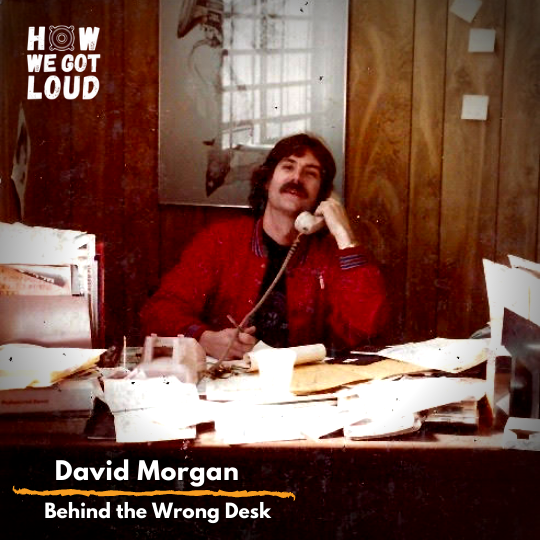
That phrase, “the wrong desk,” says a lot. David is a mixer. He is also a musician at heart. But for a period in the early 1980s, he found himself pulled into the business side of live sound: managing people, gear, clients, payroll, insurance, sales calls, system design, and the pressure of keeping a sound company alive.
As David says in this episode, running a sound company can be a heartbreaking job unless that is truly what you want to do.
For David, it was not where he ultimately belonged. But it changed him.
It gave him a deeper respect for the relationship between freelance front-of-house engineers and the sound companies supporting them. It gave him firsthand experience of the supply side of the business — the side most engineers only complain about when the gear truck opens. It also placed him right in the middle of a major transition period in West Coast live sound history.
In my first conversation with David, back on Episode 2, we touched briefly on some of this. But we only scratched the surface. I wanted to go back and dig deeper into his early years around A1 Audio, Tycobrahe, Innovative Audio, and Schubert Systems Group.
This episode is about David Morgan, but it is also about a specific moment in the live sound business when everything was moving fast. Companies were splitting. Engineers were branching out. New systems were being designed. Touring expectations were changing. And a lot of people were figuring it out in real time.
From the Palomino to A1 Audio
Before David found himself managing a sound company, he had already worked in studios and mixed club gigs around Los Angeles. One of those important early jobs was at the Palomino in North Hollywood.
Through that connection, David was introduced to A1 Audio.
A1 Audio was started in 1969 by Al Siniscal. The company began in Las Vegas and later expanded into Hollywood and other locations. At the time, A1 was supporting artists like Paul Anka, The Doobie Brothers, Frank Sinatra, and others.
For David, going from the Palomino to A1 was a major shift. He describes it as almost being picked up by a crane and dropped into a completely different life. Suddenly he was around trucks, power distribution, intercoms, touring systems, and all the things required to build a show from scratch — things he had not really dealt with when mixing on house-provided systems.
A1’s Hollywood location also put him inside a larger ecosystem. Around the Columbia lot were rehearsal stages, management offices, lighting companies, sound companies, and people moving in and out of major tours. Penguin Management, SIR Hollywood, C-Factor Lighting, Delicate Audio, and others were all part of that surrounding world.
That matters because live sound history is often told through the companies, but the scene itself was just as important. These people were crossing paths, borrowing ideas, competing for work, and learning from each other in real time.
Learning the Sound Company Side
David did not walk into A1 as a seasoned touring sound-company designer. He learned fast.
He talks about working with Bobby Ross, A1’s head engineer, and being mentored by people like Mark Gander from JBL. Gander did not just sell drivers. He brought books, shared knowledge, and helped David understand acoustics, psychoacoustics, cabinet design, monitors, porting, and how sound systems actually behaved.
That JBL relationship is an important piece of the story. In that era, JBL was not simply a manufacturer shipping parts. They were a key partner to many growing sound companies. They provided drivers, design help, financing relationships, and technical guidance. Companies like A1, Clair, Showco, Tycobrahe, and others were building their own systems, but JBL was deeply tied into that development.
At A1, David started translating what he heard on gigs into practical changes back at the shop.
He talks about struggling with monitor systems that did not give the band what they needed. The Community fiberglass monitor “buckets” and other existing wedges were not delivering the punch or clarity he wanted. After one tour, he came back convinced that A1 needed to rethink its monitor situation.
That is one of the important parts of David’s story. He was not just reading spec sheets. He was hearing problems on stage, then bringing those problems back to the shop and trying to solve them.
The same thing happened with A1’s flying system. He describes the old VIP system as physically difficult and, at times, dangerous to work with. Large frames, ratchet straps, and cabinets stacked high in outdoor conditions were not just inconvenient — they were a real-world problem. David helped rethink how the system could be flown, aimed, and used more practically.
That early period at A1 gave him a crash course in the technical and operational side of live sound. It also helped build the reputation that later led to one of the stranger turns in his career.
Tycobrahe, Innovative Audio, and a Changing West Coast Scene
At the same time David was coming up through A1, another major West Coast sound-company story was unfolding.
Tycobrahe started in 1968 and became one of the important early sound companies on the West Coast. They were among the first companies to package and tour complete sound systems across the country with major artists. Before that, most sound companies were still primarily regional.
Tycobrahe went on to work with bands like Black Sabbath, Deep Purple, The Rolling Stones, Fleetwood Mac, Jethro Tull, and others. Inside that company, people like Jim Gamble, John Judnich, and Dirk Schubert were helping push live sound technology forward.
Jim Gamble’s early console work included the well-known Tycobrahe Black Board and Blue Board. Dirk Schubert was heavily involved in electronics, filters, crossovers, and system design. These were not just rental companies. They were building and modifying the tools that touring sound needed before the industry had fully standardized.
In 1979, Tycobrahe was sold and became Innovative Audio.
That moment became a splitting point. Jim Gamble went on to build consoles under his own name. Dirk Schubert and his father formed Schubert Systems Group. Innovative Audio continued forward with the gear, ideas, and legacy that came out of Tycobrahe, but with a new name and a complicated road ahead.
David was not there at the exact moment of the sale. He was still connected to A1 and touring work. But by 1981, everything changed.
The Call from Jim Gamble
In the spring of 1981, David Morgan got a call from Jim Gamble.
He had never met Gamble before.
That is part of what makes this story so interesting. David had heard the name Gamble by then, mostly because people around A1 were talking about Innovative Audio taking the Doobie Brothers account away. The engineers wanted to use Gamble consoles, and that was a major blow to A1.
So when Gamble called and asked David to go help his friends at Innovative Audio, David was walking into a company whose name already carried tension from his A1 world.
At first, David thought he was simply there to observe and report back. He jokingly describes it almost like being asked to play industrial spy. But that was not Gamble’s intention. Gamble wanted David to help fix what was wrong and get the company back on its feet.
David walked into Innovative Audio in Carson, California, and found chaos — but he also found gear that sounded incredible.
Hearing the Gamble Console
One of the strongest technical moments in the episode is David’s first reaction to the Gamble console.
Coming from A1, where he had worked on Yamaha PM2000s and other gear, David was not expecting what he heard. The Gamble console reminded him of studio-quality audio. He talks about the punchy bottom end, warm midrange, and brilliant highs that were not painful or piercing.
That moment matters because it explains why engineers cared so much about those desks. This was not just brand loyalty. There was a sound and a feel to the Gamble consoles that people responded to.
At Innovative, David found himself surrounded by premium handmade audio tools, custom electronics, and the remnants of a company that had been part of building the early language of touring sound.
But good gear was not enough.
Innovative had a name-recognition problem. David says, looking back, they probably should have kept the Tycobrahe name. By changing it, they had cut themselves off from the history and recognition that Tycobrahe had built. The company had great equipment and talented people, but it had to rebuild trust and visibility under a new identity.
Running a Sound Company
David eventually became general manager of Innovative Audio.
This was never the plan. He did not come from a business background. He still saw himself as a guitar player and a mixer. Suddenly he was dealing with payroll taxes, health insurance, sales calls, staffing, client relationships, gear logistics, and the pressure of keeping a company alive.
He had help. He talks about people like Linda DeCosta, who helped keep the office together, and Bob Bogdanovich, one of the original Tycobrahe figures, who would visit and share practical advice from his own experience running the company.
David also talks about the talent pool around Innovative and later Schubert Systems Group. People were coming in and out of the doors who would go on to have long careers in the industry. The company may not have been the biggest, but it had strong people and strong gear.
The client list began to grow again. David mentions artists and acts connected to that era including The Doobie Brothers, Bonnie Raitt, Waylon Jennings, Willie Nelson, Toto, The Tubes, and Michael McDonald. Innovative was trying to rebuild itself into a viable touring sound company.
But the job took a toll.
David describes that period as creatively frustrating. His artistic outlet was stifled. Instead of expressing himself behind a console, he was expressing creativity through system design, company decisions, and trying to take care of his crew.
That is the core of the “wrong desk” idea. He was doing meaningful work. He was learning. He was contributing. But he was not where he was supposed to be.
From Innovative Audio to Schubert Systems Group
In 1983, Dirk Schubert and his father bought Innovative Audio and folded it into Schubert Systems Group.
David was offered a one-third partnership if he stayed. Once again, he found himself wondering how a guitar player had ended up in that position.
The Schubert period included a lot of technical development. David and Dirk wanted systems that sounded good but also worked efficiently in the real world. One of the stories in this episode involves building systems around TT patch bays, QL connectors, and rack interconnects so that front-of-house systems could be set up extremely quickly.
For the Doobie Brothers’ 1982 farewell tour, David describes a front-of-house system that could be wired in minutes, including getting the consoles out of the cases. That kind of detail says a lot about where the touring industry was headed. It was not just about louder systems. It was about repeatability, efficiency, packaging, and making complex rigs work night after night.
David also gets into the less glamorous side of that progress: connector problems, G connectors, pins backing out, snake-building parties in Dirk’s garage, and the handwork behind systems that audiences never saw.
That is part of what makes this interview valuable. It captures the practical details behind the big company names.
Innovative Was Building, Not Just Inheriting
One detail worth preserving is that Innovative Audio was not simply coasting on old Tycobrahe inventory.
David makes it clear that Innovative had built a lot of its own gear. In fact, part of the company’s financial difficulty came from overextending itself while trying to build and update equipment. They had built new monitors and continued developing systems beyond what had come directly from Tycobrahe.
That nuance matters. It is easy to tell the story as Tycobrahe ended, Innovative existed briefly, and Schubert came next. But the reality was more complicated. There was real design work, real financial pressure, and real effort to keep progressing.
Back to the Mixing Desk
By early 1986, David and Dirk went separate directions.
David was burnt out. He did not want to keep running a sound company. He did not want to be a sales consultant. He wanted the artistic side of his life back.
That next chapter brought him into the orbit of Maryland Sound.
After Bob Goldstein and Maryland Sound bought Northwest Sound from Bob Stern, David became connected to MSI’s West Coast efforts. But what he really wanted was to mix again.
That opportunity came with Whitney Houston.
In 1986, Whitney went out on her first solo tour. When a change happened at front of house, Ronnie Smith from Maryland Sound called David and asked if he wanted to give Whitney a shot. David said yes. He stayed with Whitney for three years, until she went off the road before The Bodyguard era.
That gig helped lead to Paul Simon.
David talks about bringing Maryland Sound into the Paul Simon world and using MSI’s high-pack / low-pack PA on the Graceland tour. He felt that system was integral to the sound of that show. Later, when the tour required a larger system for stadiums in Europe, the production shifted back to Clair.
This opens up another important theme in the episode: the relationship between engineers, production managers, artists, and sound companies.
David explains that even then, sound-company decisions were often tied to relationships with production managers. A front-of-house engineer could have influence, but usually only if the production manager was aligned, or if there had been a major “watershed” event that forced a change.
That is a valuable perspective because it connects the early sound-company world to the way touring still works today.
The Lesson of the Wrong Desk
The irony is that David’s time behind the wrong desk made him better when he got back behind the right one.
He understood what sound companies were dealing with. He understood inventory, cost, risk, staffing, and the pressure of supporting demanding tours. He knew what it felt like to be on the other side of the phone when an engineer asked for something unreasonable, expensive, or impossible.
Because of that, he became a better client.
He talks about trying to make gear requests that work with what a company already owns. If he asks a sound company to buy something, he wants it to be something other engineers will use too — not just a one-off request for him.
That may be one of the most important takeaways from the episode. David did not love running a sound company. But those five years gave him a perspective that stayed with him for the rest of his career.
He learned what it meant to serve the artist from both sides of the desk.
In This Episode
In this conversation, David Morgan talks about:
Moving from the Palomino into A1 Audio
The Columbia lot and the Hollywood touring sound scene
A1 Audio’s Las Vegas and Hollywood presence
Working with Bobby Ross and learning from Mark Gander at JBL
Redesigning monitors and rethinking practical flying systems
The role JBL played in helping early sound companies develop systems
Tycobrahe’s transition into Innovative Audio
Jim Gamble’s consoles and the legacy of the Black Board and Blue Board
Dirk Schubert’s work in electronics, filters, and system design
Getting called by Jim Gamble to help Innovative Audio
Becoming general manager of a sound company almost by accident
The chaos, pressure, and education of running Innovative Audio
The transition into Schubert Systems Group
QL connectors, TT patch bays, G connectors, and system packaging
The Doobie Brothers, Bonnie Raitt, Waylon Jennings, Toto, The Tubes, Michael McDonald, Whitney Houston, and Paul Simon
Maryland Sound, Northwest Sound, MSI West, and the high-pack / low-pack PA
The Graceland tour and the later shift back to Clair
Why his time behind the wrong desk made him a better front-of-house engineer
This episode is about David Morgan’s career, but it is also about a fast-moving chapter in live sound history. It captures the moment when regional companies were becoming national touring providers, when engineers and designers were still building the tools they needed, and when the business side of live sound was becoming just as important as the gear itself.
Listen to my conversation with David Morgan and hear how he ended up behind the “wrong desk” — and how those five years helped shape the engineer he became.